Today’s problem
https://leetcode.com/problems/minimize-xor/description/
XOR
This is the True-False Diagram for $XOR$:
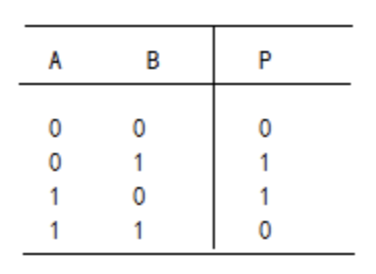 In this diagram, we can find that if A and B is the same, then $A\space XOR\space B = 0$; else, $A\space XOR\space B = 1$.
Intuition
-
For the first requirement in the question, “same number of set bits” means “same number of bit 1 in the number”.
-
Why? This is because the number of 0 in a number can be infinity, while only the number of bit 1 is finite.
-
Therefore, we need to count how many 1s are there in number2.
-
Now, based on the $XOR$ Diagram we know that to make a number after doing $XOR$, we need to put a one in the same position where number1 has a 1, so that we can decrease it to 0 after doing $XOR$.
-
In this case, we want the “decreased” 1s from top to down to minimize the result.
-
If there are more 1s in number2 than number1, we would have to add new 1s to the result.
-
In this case, we want to “add” 1s from down to top to minimize the result.
Approach
- Use $bit_count()$ function to count the 1s in num2.
- Iterate from top to down to decrease 1.
- Iterate from down to top to add 1.
Complexity
-
Time complexity: $O(log_2(N))$, N means the number.
-
Space complexity: $O(1)$, only some variables are stored
Code
class Solution:
    def minimizeXor(self, num1: int, num2: int) -> int:
        cnt,ans = num2.bit_count(), 0
        for i in range(31, -1, -1):
            if cnt > 0 and (num1 & (1 << i)) > 0:
                ans += (1 << i)
                cnt -= 1

        for i in range(31):
            if cnt > 0 and (ans & (1 << i)) == 0:
                ans += (1 << i)
                cnt -= 1

        return ans